Fourteen Stations, One Narrow Street: A Pilgrim's Morning on the Via Dolorosa
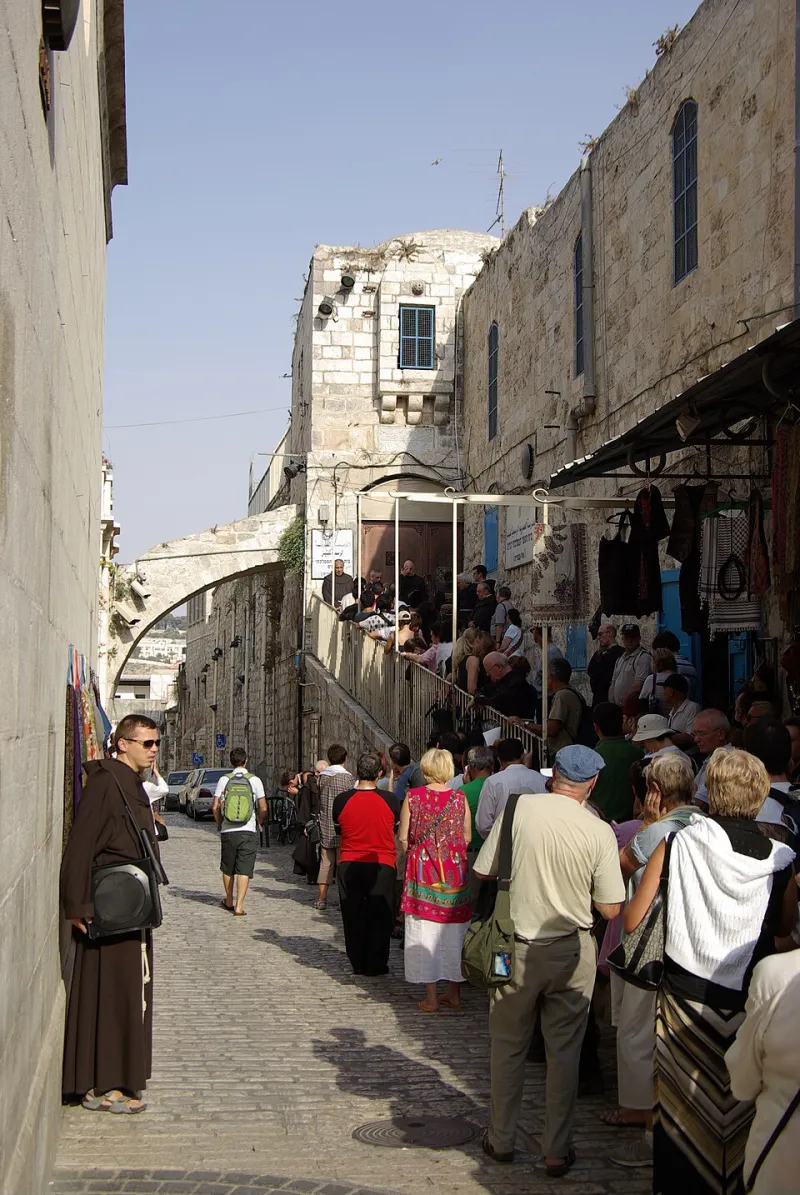
Photo: Berthold Werner, CC BY-SA 3.0, via Wikimedia Commons
Before Dawn Inside Lion's Gate
The first thing you notice is the quiet. Not silence—Jerusalem's Old City never offers silence—but a hush that settles over the Muslim Quarter before the shops open and the crowds arrive. If you pass through Lion's Gate at seven in the morning, the light is still gold and low, catching the top of the stone walls the same way it must have caught them two thousand years ago. This is where the Via Dolorosa begins, or at least where tradition says it begins, and where thousands of pilgrims each year start the most famous half-mile walk in human history.
For American travelers accustomed to wide sidewalks and clearly marked historic sites, the first surprise is how ordinary it all feels. The Via Dolorosa is a living street. Laundry hangs from balconies. Vendors roll up metal shutters. Children dart between pilgrims clutching wooden crosses and guidebooks. And that ordinariness, many pilgrims discover, is precisely the point. Jesus did not carry the cross down a monument. He carried it down a street like this one—crowded, commercial, indifferent.
The Stations Begin
The traditional route traces fourteen Stations of the Cross, nine along the street itself and five inside the Church of the Holy Sepulchre. The first station stands at the site of the Antonia Fortress, where Jesus was condemned by Pontius Pilate. From there, the path winds roughly six hundred meters through the Old City's twisting lanes.
Each station is marked—some with simple metal plaques, others with small chapels. At the third station, where tradition holds that Jesus fell for the first time, a carved stone relief above the doorway shows him collapsing beneath the beam. Pilgrims often linger here without speaking. There is little to say. The scripture readings many groups recite at each stop come from the Gospel accounts: "And he bearing his cross went forth into a place called the place of a skull" (John 19:17, KJV).
The sensory details accumulate as you walk. Incense from a nearby church mingles with the smell of fresh bread from an oven vent. Your feet find the worn, convex paving stones that tilt unexpectedly. The sound of the Friday call to prayer sometimes overlaps with a Latin hymn sung by a pilgrim group from Ohio or a choir from Lagos. The Via Dolorosa belongs to everyone, and everyone brings their own voice to it.
Carrying What You Carry
Somewhere around the fifth station—where Simon of Cyrene was compelled to carry the cross—many pilgrims report a shift. The walk stops being a tour and becomes something else. A retired schoolteacher from Dallas on one recent pilgrimage described it this way: "I came to see where it happened. Somewhere around Simon's station, I realized I was supposed to be carrying something of my own the whole time."
That is the quiet power of this street. The physical act of walking uphill through narrow stone passages, pausing at each station, mirrors the spiritual act of bearing what we bear. At the eighth station, where Jesus addressed the women of Jerusalem, the words of Luke 23:28 take on startling intimacy when spoken aloud in a crowded alley: "Daughters of Jerusalem, weep not for me, but weep for yourselves, and for your children."
Arriving at Golgotha
The final five stations unfold inside the Church of the Holy Sepulchre, the ancient basilica that encloses both Golgotha and the tomb. Pilgrims enter through the courtyard and climb a steep staircase to the Chapel of the Crucifixion, where a silver disc marks the traditional spot of the cross. Below, in the rotunda, the Edicule encloses the tomb itself.
Plan to spend time here—far more than you think you need. The church is a layered, chaotic, magnificent place shared by six Christian denominations, and it rewards patience. Light a candle. Find a quiet column. Sit with the fact that you have walked from condemnation to burial in the space of a morning.
Practical Counsel for the American Pilgrim
Timing matters. The Friday processions led by the Franciscans begin in the afternoon and draw enormous crowds. For a contemplative walk, arrive early—before eight in the morning—or visit midweek in the shoulder seasons of March, April, October, or November.
Dress and pack sensibly. Modest attire is required at holy sites; shoulders and knees should be covered. Wear broken-in walking shoes, as the stones are uneven and occasionally slick. Carry water and a printed station guide, since phone batteries drain quickly in the crowds.
Go with a group or a guide the first time. The route is not always intuitive, and the stations are not always numbered in sequence. Most US-based pilgrimage ministries offer ten- to twelve-day Holy Land itineraries that include the Via Dolorosa alongside the Sea of Galilee, the Mount of Olives, and Bethlehem.
Prepare your heart before you prepare your feet. Read the Passion narratives in the days before your walk. Many pilgrims find that praying the Stations of the Cross at their home parish first makes the Jerusalem walk profoundly richer.
The Walk That Keeps Walking
Every pilgrim returns home with a different memory. Some remember the weight of the crowd. Some remember a single stone under their palm. But nearly everyone agrees on one thing: the Via Dolorosa is not a place you visit once and file away. It becomes a point of reference for the rest of your life of faith.
You walked where He walked. You stumbled where He fell. And somewhere between Lion's Gate and the empty tomb, the distance between the first century and your own life narrows to the width of a stone street—narrow enough, at last, to walk across.