Golden Hour at the Kotel: A Christian Pilgrim's Friday Vigil in Jerusalem
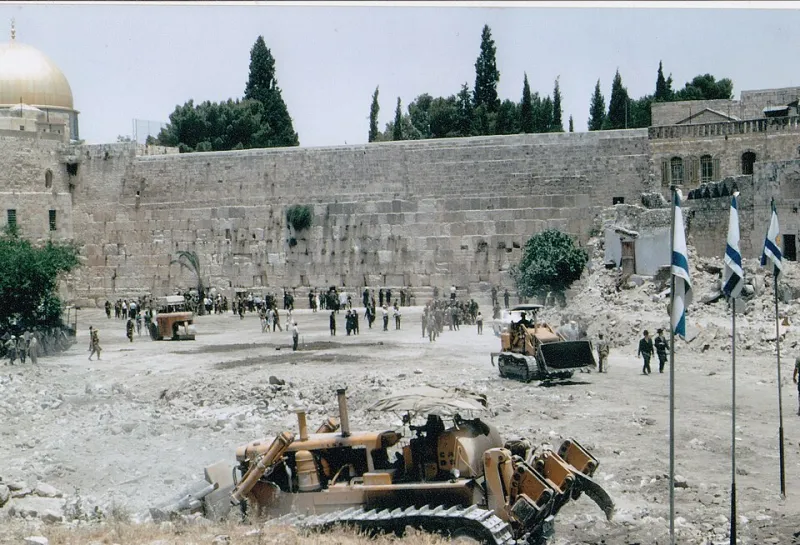
Photo: יהודה גרינברג, CC BY 2.5, via Wikimedia Commons
An Appointment With the Closing Light
Jerusalem does not ease into Friday evening. The city quickens. Buses fill, shopkeepers lower their shutters, and the light along the ancient stones turns a deep, honeyed gold. By the time the sun begins its descent toward the Judean hills, the plaza before the Western Wall has become a gathering of the hopeful, the hurried, the grieving, and the grateful.
For a Christian traveler from the United States, the scene can feel both familiar and foreign. The psalms are ours. The longing for God's house is ours. But the rhythm of preparation here belongs to another household of faith, one we are invited to honor rather than absorb. A Friday vigil at the Kotel—the Western Wall—is not a trophy stop on a Holy Land itinerary. It is a lesson in prayer that has been practiced longer than most of our churches have stood.
The Stones and the Story
The Western Wall is not the Temple itself. It is a retaining wall of the Temple Mount platform, built in the first century BCE under Herod the Great and expanded across the generations. That distinction matters for the Christian pilgrim. We do not come to venerate masonry. We come to stand within sight of the place where Israel's worship centered, where Jesus taught, where the Gospels place His cleansing of the Temple, and where He wept over Jerusalem.
Luke records that as Jesus approached the city, He saw it and wept over it. That grief is not foreign to the Wall. Prayers offered here have always carried a double edge: gratitude for God's faithfulness and sorrow over what remains unredeemed. Christians do not need to resolve that tension before arriving. We need only arrive honestly.
The prophet Isaiah heard God promise a house of prayer for all peoples. The Temple Mount has never been a simple place—it has been contested, destroyed, rebuilt, and contested again. Yet the promise lingers like evening light on stone. For the pilgrim, the Wall is a reminder that prayer is not an escape from history but an entry into it.
Before You Go: Timing and Temperament
Friday at the Western Wall requires planning, especially in the hours before Shabbat. Candle-lighting times move with the seasons, so check the official Jerusalem times for the week of your visit. Arrive well before sunset—not merely for security screening and crowds, but to let your spirit slow down. The plaza is busiest as families gather, bar mitzvahs are celebrated, and soldiers in uniform slip in for a moment of quiet.
Dress modestly. Men should bring a head covering; simple paper kippot are often available at the entrance. Women should choose clothing that covers shoulders and knees. These are not arbitrary rules but signs of respect in a living community of prayer. Keep phones silenced. If you would not photograph during a solemn moment in your own church, do not do so here. When in doubt, follow the quieter custom.
The plaza is divided into men's and women's sections. As a Christian, you are a guest. Pray where you are welcome, not where you wish to make a point. Avoid proselytizing. Avoid loud speech. If you bring written prayers, remember that many pilgrims tuck folded papers into the crevices of the stones. The practice is tender, not magical; it is a way of leaving before God what words cannot carry.
Praying Beside, Not Instead Of
There is a temptation for Christian pilgrims to treat Jewish prayer as a prelude to our own. That temptation should be resisted. The people beside you at the Wall are not actors in a Christian lesson. They are Jews, praying in the continuity of a covenant they understand differently than we do. Our presence is not an improvement on theirs. It is a sharing in the same human need for mercy.
Stand at a respectful distance. Listen. Notice the rocking of prayer, the whispered Psalms, the soldiers with their hands over their faces, the elderly woman tracing letters in a prayer book. Your own prayers may rise in English, or in the words of Jesus, or in silence. That is enough.
Christians believe that Jesus is the fulfillment of Israel's hope. But fulfillment is not contempt. If the Wall teaches us anything, it teaches patience—the patience of a people who have kept praying through exile, war, and return. The apostle Paul described his kinsmen according to the flesh as bearing the covenants and the promises. A Christian at the Kotel does well to remember that the story of salvation did not begin with us.
When Shabbat Arrives
As sunset nears, the character of the plaza changes. The last hurried arrivals come through security. Families gather. The sound of greeting rises. Then, almost imperceptibly, the noise softens. Shabbat is arriving, and with it a different kind of time.
You may not stay for the full welcome. You may not understand the Hebrew. But you can receive the moment as a gift: the sight of a city keeping faith with an ancient command, the sound of prayer folding into stone, the golden light that makes even concrete look carven. For the pilgrim, this is not an exotic spectacle. It is a call to examine our own observance, our own hurry, our own habits of prayer.
When you leave, do so slowly. Many visitors walk backward for a few steps, unwilling to turn their backs on the place. You need not adopt every custom. But you can carry the posture home: attention, humility, and the willingness to pray beside others rather than over them.
The Wall does not save anyone. But it stands as a witness. And on a Friday at sunset, when the light turns gold and the city exhales into Sabbath, a Christian pilgrim can learn something the modern world forgets: that prayer is not a private performance but a shared inheritance, kept alive by people who refuse to stop speaking to God.