Where the Ordinary Preaches: A Slow Half-Day in Capernaum
The bus pulls in, the group walks the site, a guide reads from Mark 1, and everyone is back aboard before the water bottles have warmed. That is the standard Capernaum visit. It is not a bad visit. It is simply too brief for a town that gave Jesus a mailing address.
Matthew 4:13 records that Jesus "left Nazareth and went to live in Capernaum by the sea." The Greek verb carries the sense of settling in — of making a home. Whatever else a pilgrim expects from the Holy Land, this much is certain: the Son of God did not commute. He had a street, a shoreline, a synagogue bench, and neighbors who knew the sound of His footsteps on stone. A half day here, unhurried, is one of the most quietly persuasive experiences the Galilee offers.
A Working Village, Not a Footnote
Capernaum — Kfar Nahum in Hebrew, "the village of Nahum" — sat on the northwest shore of the Sea of Galilee, straddling a road that carried commerce between the Mediterranean coast and the interior. Its fishermen worked the lake in the cool hours; its farmers pressed olives and milled grain; a customs post collected tolls on goods moving through. The village was, in the plainest sense, ordinary. That ordinariness is the point.
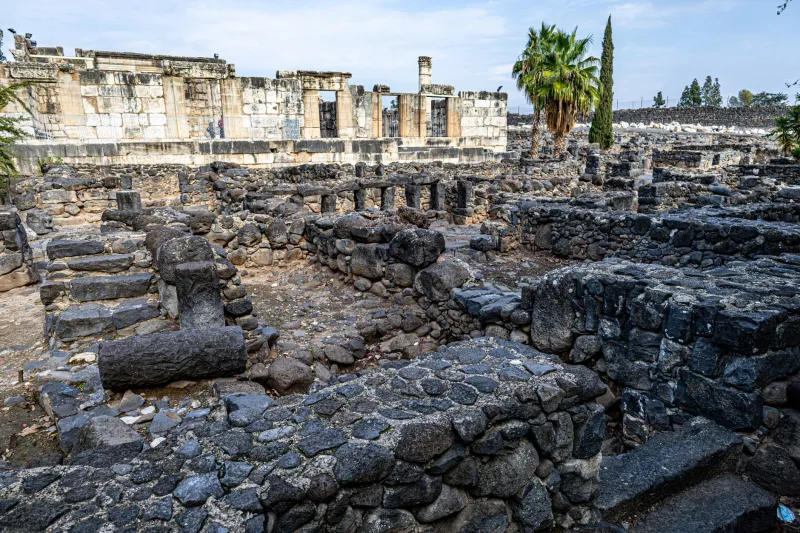
Walking the site today, most visitors move straight for the two headline structures. Resist that instinct for a moment. Begin instead with what the excavations have laid out in the open: worn basalt walls, thresholds grooved by generations of feet, weights, tools, storage jars. The Gospel of John insists that "the Word became flesh and made his dwelling among us" (John 1:14). The Greek word for dwelling is eskenosen — He pitched a tent. Capernaum is where the tent pegs went into actual soil.
The Synagogue, and What Is Under Your Feet
Stand in the shadow of the white limestone synagogue and take note of the black basalt foundations beneath it. The limestone structure you see belongs to the fourth or fifth century, but it rises over an earlier building — and that earlier building is almost certainly the one where Jesus taught. Mark 1:21 says that on the Sabbath He "went into the synagogue and began to teach," and the people were astonished, "because he taught them as one who had authority." Luke adds that a man possessed by an unclean spirit cried out in that same room.
Read Mark 1:21–28 standing still, if you can. Then walk the perimeter and notice the carved capitals, the basalt benches, the lintels. This was not a cathedral. It was a village meeting house that smelled of lamp oil and damp wool. The authority that astonished them was spoken in a room this size.
The House That Would Not Stay Ordinary
Just south of the synagogue lies the structure every guide calls Peter's house — an insula of basalt rooms that, by the fourth century, had been singled out for Christian worship and, by the fifth, covered by an octagonal church. A modern memorial church now floats above the ruins on columns, preserving the floor beneath. From the railing, you can look down into the rooms where a family once cooked, slept, and argued.
Here is where a pilgrim should stand longest. Mark 2 describes a paralytic lowered through a roof because the doorway was impassable. Luke 4:38 tells of Peter's mother-in-law healed of a fever; that evening, the whole town gathered at the door. Jesus healed many in Capernaum — and Capernaum, Matthew 11:23 records, still failed to repent. Both facts belong to this floor. Proximity to Jesus is not the same as surrender to Him, and a pile of basalt is honest about that.
Millstones and the Weight of Small Things
Scattered through the site are basalt millstones, some large enough to require a donkey, others small enough for a household. Look at them and hear Matthew 18:6 — a warning about a millstone hung around the neck. Jesus was not being abstract. He had watched these stones turn every morning. The imagery landed because the object was familiar.
This is the great gift of a slow walk: the parables stop being illustrations and become inventory. The sower, the net, the lamp under a bowl, the mustard seed — all of it was just village life, and Jesus pressed it into service.
Hooks, Weights, and the Tools of a Calling
In the small museum and interpretive displays, you will find bronze fish hooks, stone net weights, and anchors recovered from the shoreline. This is where Mark 1:16–20 becomes tactile: two brothers casting a net, a voice calling them to become fishers of men. Matthew 17:24–27 places the temple-tax coin in a fish's mouth — an odd, homey miracle that only makes sense among men who knew how a hook is baited and where a fish is cleaned.
Walk to the water's edge and look north and south along the shoreline. This is the lake that was stirred into a storm while Jesus slept in the stern (Mark 4:37–39). The distances are small. Everything in the Gospels is close together.
Doorways, Stairs, and the Architecture of Welcome
Take time with the thresholds. Ancient doorways were low and the stone was soft; centuries of sandals wore them into shallow saddles. Roofs were flat, reached by an outside stair, used for drying produce, sleeping in summer, and — occasionally — being torn open for a friend. Hospitality in Capernaum was not a sentiment. It was architecture, and it was open.
A Sensible Route for the Half Day
Arrive near opening. Spend twenty minutes at the synagogue, then twenty at Peter's house. Give the shoreline and the outdoor ruins forty minutes, and reserve fifteen for the museum. Read Mark 1 and Mark 2 in full before you arrive; read nothing while you walk. If your schedule allows, the walk north toward Tabgha is flat and quiet, and it lets the site settle.
Practical Counsel for the American Traveler
The site is administered by the Franciscan Custody of the Holy Land; modest dress is expected, and voices should be low. There is minimal shade and the basalt holds heat — bring water and a hat, especially in summer. Hours shift with the Jewish and Christian calendars, so confirm before you go. Restrooms are available on site, and the ground is uneven enough that sturdy shoes matter.
What to Carry Home
Capernaum will not overwhelm you the way Jerusalem does. It has no golden dome, no monumental staircase. It has doorways. That is its testimony. The Word became flesh in a village where people milled grain and mended nets and wore down their thresholds — and He was, for a time, one of the reasons the threshold wore.
Leave a little longer than your itinerary suggests. Stand at the water, look back at the black stones, and let the plainness do its work. You will read the Gospels differently on the plane home.